Wednesday, March 18, 2009

Thursday, March 12, 2009
Monday, March 9, 2009
Examples
Through the use of celebrities and entertainment venues, the message of environmental awareness and sustainability reaches out to a wider audience and attracts a lot of attention. However, some of these events held for environmental awareness are not necessarily environmentally-friendly and some of these celebrities SAY they are doing their part for the environment but DO not live up to their commitment. Let's look at some examples of environmental "do's and don't do's".
A Don't Do:
The "Live Earth" Concert
The Live Earth event consists of nine concerts--played over 24 hours across seven continents and before an audience of two billion. It is run by former Vice President Al Gore, and over 150 artists will be performing; such as The Police, Red Hot Chili Peppers and Madonna. On a green, energy-efficient note, these 150 performers will be "jetting" around to perform in various locations, from Tokyo to Hamburg. Talk about reducing the carbon footprint.
Madonna, who will be calling for mass global change to reduce carbon emissions and tackle climate crisis, arrived by private jet to the concert. Contradictory? I think so. In addition, Madonna produces 100 times the average waste that a single British citizen produces in a year. She also has a Mercedes Maybach, two Range Rovers, an Audi R8 and a Mini Cooper S at home. Talk about saving the planet.
Globally, this concert is expected to produce 1,025 tons of waste. At the Wembley venue, they only have the capacity to recycle a third of the waste produced--with the rest going to landfills. Additionally, each person that attends the concert will have to make a return trip: whether by car, air, rail, or bus which is burning fossil fuels--exactly what the concert is trying to promote the reduction of. Coincidence? I think NOT.
Do:
Reverb
A Don't Do:
The "Live Earth" Concert
The Live Earth event consists of nine concerts--played over 24 hours across seven continents and before an audience of two billion. It is run by former Vice President Al Gore, and over 150 artists will be performing; such as The Police, Red Hot Chili Peppers and Madonna. On a green, energy-efficient note, these 150 performers will be "jetting" around to perform in various locations, from Tokyo to Hamburg. Talk about reducing the carbon footprint.
Madonna, who will be calling for mass global change to reduce carbon emissions and tackle climate crisis, arrived by private jet to the concert. Contradictory? I think so. In addition, Madonna produces 100 times the average waste that a single British citizen produces in a year. She also has a Mercedes Maybach, two Range Rovers, an Audi R8 and a Mini Cooper S at home. Talk about saving the planet.
Globally, this concert is expected to produce 1,025 tons of waste. At the Wembley venue, they only have the capacity to recycle a third of the waste produced--with the rest going to landfills. Additionally, each person that attends the concert will have to make a return trip: whether by car, air, rail, or bus which is burning fossil fuels--exactly what the concert is trying to promote the reduction of. Coincidence? I think NOT.
Do:
Reverb
argument
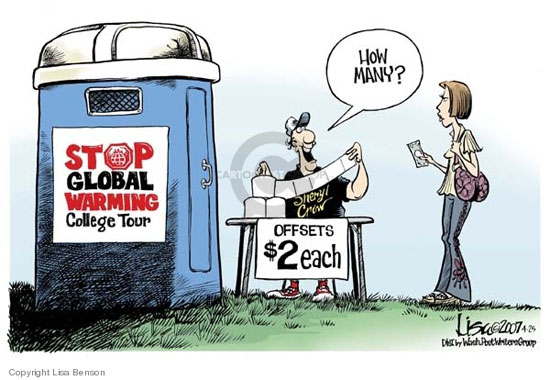
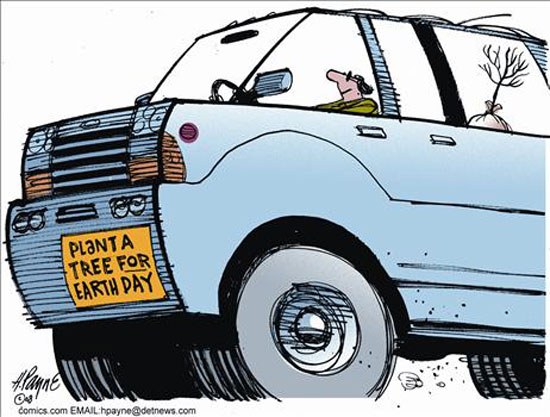
While there has been a notable surge recently in support of environmental initiatives and sustainable practices, much of this "activism" is backed by little or no actual action. From the proliferation of greenwashed products to celebrity endorsements, people and companies are jumping on the environmental bandwagon at a rapid rate. Merely creating the illusion of eco-friendliness will not stop the effects of global warming; people need to put their money where their mouth is.
While it is an important first step for people to recognize environmental issues, simply supporting change verbally is not enough. Companies are taking advantage of the popularity of environmentally friendly products, and by using ambiguous labeling and "green" buzzwords like "natural," they fool consumers into purchasing products that may not really be good for the environment. It is a sad situation when consumers can't trust the labels on their products, and need to go shopping with a healthy dose of skepticism.
Because the major effects of global warming are not necessarily visible to everyone, and do not yet negatively impact many people's everyday lives, it is easy to recognize that something needs to be done but take no personal action. However, we cannot afford to wait until global warming has become a fill-fledged disaster. Action needs to be taken now, and taken on a large scale in order to prevent irreversible environmental damage and devastating effects. Greenwashing and statements of support are not enough. Many celebrities claim to be activists for environmental issues, but still arrive at events by personal jet, and live in sprawling mansions. As those who have an immense amount of resources at their disposal, it should be easy for them to implement energy-saving devices and lessen their carbon footprint. And although some may not like to admit it, celebrities are role models for many people, and their efforts might inspire others to make changes in their lives as well.
Many large corporations attempt to illustrate their commitment to environmentalism through commercials and advertising, giving consumers a false image of their actions and the goals of the company. Because people cannot see what actually goes on behind the scenes, and are often unaware of the processes that take their products from the company to the store shelves, they depend on the image the company projects. By putting an emphasis in advertising on their "environmentalism" or their "eco-friendliness," companies convince consumers that they are a good choice and are taking steps to address their environmental impact, which in many cases may not be true.
Skewing facts and figures and greenwashing products and advertisements is misleading and enables corporations to continue environmentally destructive practices while continuing to receive the support of mislead consumers. Companies must be held accountable for their products and their advertisements if they claim to be "green," the creation of an outside organization that monitors labeling and advertisements, or that can provide certification of products and commercials might make a difference, and may enable consumers to know for sure that what they are purchasing or watching is legitimate. Activists must walk the walk if they talk to the talk and encourage others to follow their lead, instead of saying one thing in public and doing another in private. After all, it's not the size of your car, it's the size of your carbon footprint, and if you drive a Prius in public but take a private jet to dinner, it makes for a pretty big footprint.
While it is an important first step for people to recognize environmental issues, simply supporting change verbally is not enough. Companies are taking advantage of the popularity of environmentally friendly products, and by using ambiguous labeling and "green" buzzwords like "natural," they fool consumers into purchasing products that may not really be good for the environment. It is a sad situation when consumers can't trust the labels on their products, and need to go shopping with a healthy dose of skepticism.
Because the major effects of global warming are not necessarily visible to everyone, and do not yet negatively impact many people's everyday lives, it is easy to recognize that something needs to be done but take no personal action. However, we cannot afford to wait until global warming has become a fill-fledged disaster. Action needs to be taken now, and taken on a large scale in order to prevent irreversible environmental damage and devastating effects. Greenwashing and statements of support are not enough. Many celebrities claim to be activists for environmental issues, but still arrive at events by personal jet, and live in sprawling mansions. As those who have an immense amount of resources at their disposal, it should be easy for them to implement energy-saving devices and lessen their carbon footprint. And although some may not like to admit it, celebrities are role models for many people, and their efforts might inspire others to make changes in their lives as well.
Many large corporations attempt to illustrate their commitment to environmentalism through commercials and advertising, giving consumers a false image of their actions and the goals of the company. Because people cannot see what actually goes on behind the scenes, and are often unaware of the processes that take their products from the company to the store shelves, they depend on the image the company projects. By putting an emphasis in advertising on their "environmentalism" or their "eco-friendliness," companies convince consumers that they are a good choice and are taking steps to address their environmental impact, which in many cases may not be true.
Skewing facts and figures and greenwashing products and advertisements is misleading and enables corporations to continue environmentally destructive practices while continuing to receive the support of mislead consumers. Companies must be held accountable for their products and their advertisements if they claim to be "green," the creation of an outside organization that monitors labeling and advertisements, or that can provide certification of products and commercials might make a difference, and may enable consumers to know for sure that what they are purchasing or watching is legitimate. Activists must walk the walk if they talk to the talk and encourage others to follow their lead, instead of saying one thing in public and doing another in private. After all, it's not the size of your car, it's the size of your carbon footprint, and if you drive a Prius in public but take a private jet to dinner, it makes for a pretty big footprint.
Sunday, March 8, 2009


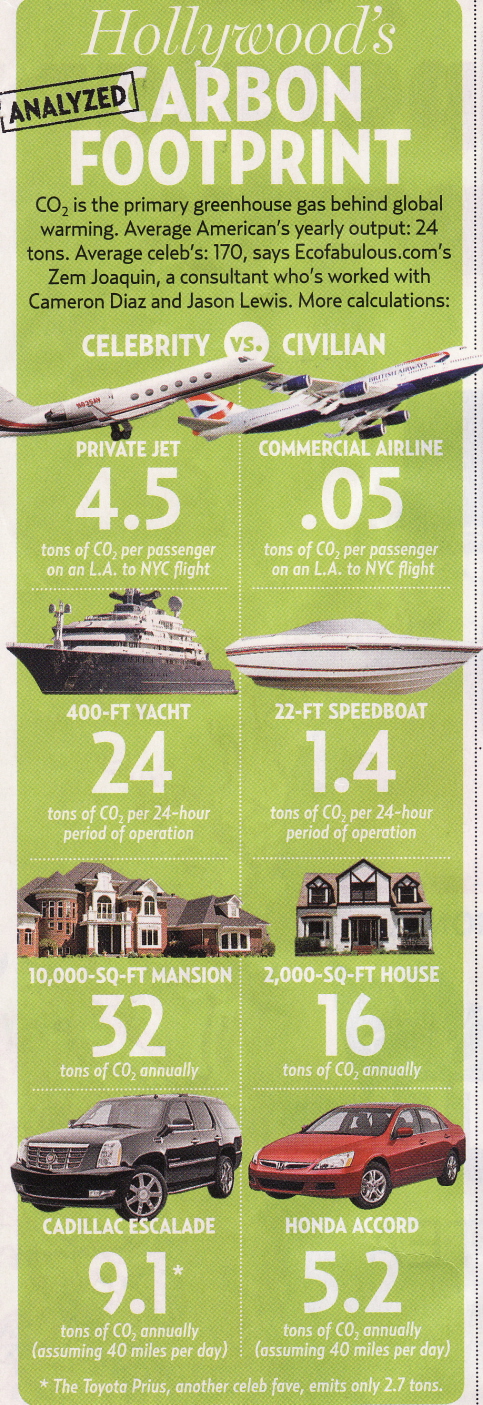
Top 5 celeb. hypocrites
1) Rock star and long time environmental campaigner Sting faced the embarrassment of having his group The Police labelled the “dirtiest band in the world” this year because of the scale of their reunion world tour and the massive carbon footprint made by fans coming to see them.
2) Former US Vice President and Nobel Peace Prize winning environmentalist Al Gore faced accusations of hypocrisy last year when a research group claimed his 20-room, eight-bathroom home consumed more electricity in a month than the average American household did in a year. Mr Gore pointed out that he had taken numerous energy saving measures and purchased offsets to reduce his carbon footprint to zero
3) The Live Earth concerts last year were aimed at saving the planet but organisers faced a backlash over the massive carbon footprint of the events themselves as 150 performers, along with their technicians and dancers, jetted around the globe to appear at various venues. The total carbon footprint of the event was estimated to be at least 31,500 tonnes of carbon emissions, according to carbonfootprint.com
4) Actor John Travolta, who has spoken of the need to come up with alternative forms of fuel, has faced criticism over his ownership of several planes including a Boeing 707 which would normally have room for 150 passengers.
5) The Prince of Wales faced embarrassment last year over a 7,000-mile round trip to the US to pick up an award for his environmental work. Some green campaigners said he should have picked it up by video link.
source: http://www.telegraph.co.uk/news/1955742/Top-five-celebrity-eco-hypocrites.html
2) Former US Vice President and Nobel Peace Prize winning environmentalist Al Gore faced accusations of hypocrisy last year when a research group claimed his 20-room, eight-bathroom home consumed more electricity in a month than the average American household did in a year. Mr Gore pointed out that he had taken numerous energy saving measures and purchased offsets to reduce his carbon footprint to zero
3) The Live Earth concerts last year were aimed at saving the planet but organisers faced a backlash over the massive carbon footprint of the events themselves as 150 performers, along with their technicians and dancers, jetted around the globe to appear at various venues. The total carbon footprint of the event was estimated to be at least 31,500 tonnes of carbon emissions, according to carbonfootprint.com
4) Actor John Travolta, who has spoken of the need to come up with alternative forms of fuel, has faced criticism over his ownership of several planes including a Boeing 707 which would normally have room for 150 passengers.
5) The Prince of Wales faced embarrassment last year over a 7,000-mile round trip to the US to pick up an award for his environmental work. Some green campaigners said he should have picked it up by video link.
source: http://www.telegraph.co.uk/news/1955742/Top-five-celebrity-eco-hypocrites.html
Subscribe to:
Posts (Atom)